Water Conservation Classroom Challenge Overview
Classroom Lab:
The Water Conservation Classroom Challenge is an innovative program for middle school students in grades 6-8, sponsored by the North Texas Municipal Water District (NTMWD). Designed to make water science immersive and engaging, this program combines lab experiments with classroom and take-home activities, plus a bonus online game.
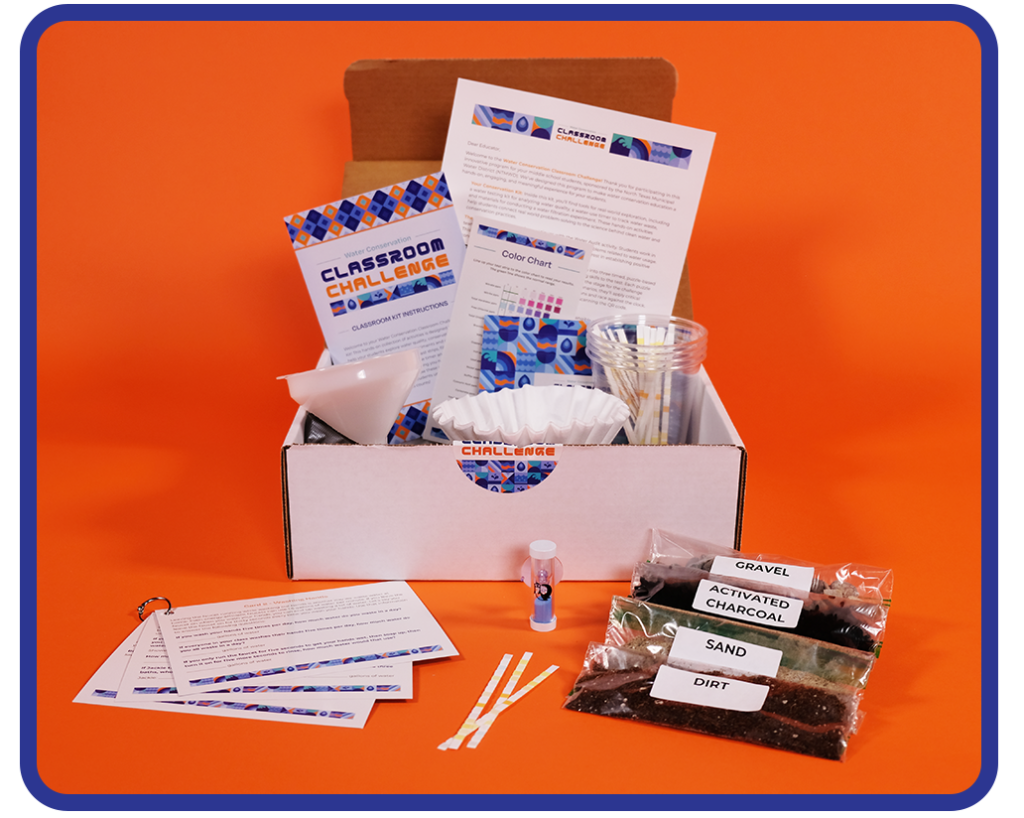
Each classroom receives a lab kit packed with tools for real-world exploration. There are water testing strips for analyzing water quality and materials for conducting a simple water filtration experiment. The learning continues with the Water Audit activity. Students work in teams as water conservation investigators, solving math problems related to water usage. An accompanying take-home activity allows students to explore their family’s water usage and ways to conserve.
Through these hands-on experiments and classroom and take-home activities, students get hands-on experience with the science behind clean water and conservation practices.
We value your feedback!
Share your opinions about the Water Conservation Classroom Challenge and let us know how your students felt about the experience. Feedback from educators like you help us to improve our programs.
Complete the survey to be entered into a drawing to win $250!
Online Game Instructions
After the experiments are complete, the bonus online game lets students dive into three timed, puzzle-based challenges that put their problem-solving skills to the test. Each puzzle begins with an engaging introductory video that sets the stage for the challenge ahead. As students work through the scenarios, they’ll apply critical thinking and teamwork to unlock solutions and work against the clock. As a digital game, it requires minimal physical setup. Here’s how to get your class ready to play:
Organize Your Teams: Divide your classroom into five teams, or fewer if you have a smaller class. Each team will work together to solve the puzzles and complete the challenges. The ideal scenario is that each group has their own device to use for viewing and solving the puzzles. Students should also have paper, pencils or pens, and access to a calculator.
Explain the Format: The game includes three puzzles, and students have 25 minutes to complete all three. Each puzzle begins with a short setup video. Teams must solve each puzzle, in order, before they can move on to the next one.
Introduce the Challenge: Have students watch the introductory video, which sets up the premise of the game and explains what they’ll be working to accomplish. The ideal scenario is that the class watches the introductory video together and then begins the three challenges with their individual teams.
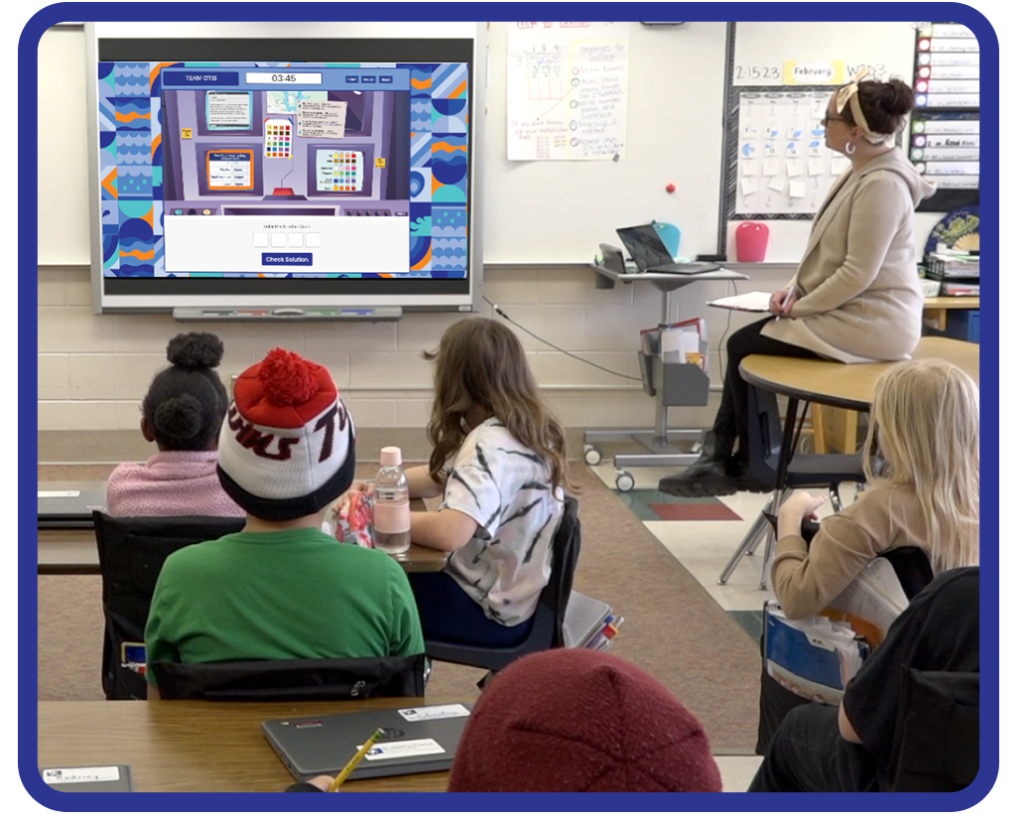
Start the Challenge: Once the students have watched the introductory video, each team clicks START and the challenge begins!
Offer Hints: If students get stuck on a puzzle, they can request hints from you. You’ll find hints for each puzzle in the Teacher Resources section.
Additional Challenge: Want to increase the excitement? Turn the game into a friendly competition by having teams race for the best completion time. Track each team’s finish time and celebrate the winning team!
Puzzle Answers and Hints
This section includes helpful hints and answers for each puzzle.
Puzzle #1
Explanation: Students should start with construction, which should be set to 1 according to the rules. Farms and businesses should both be set to 3 since they use the same amount of water—more than construction and power plants, but less than homes. The power plant must be set to 2 since nothing can be set to 4, and it uses more water than construction but less than farms. Homes must be set to 5 since they use the most water and nothing is set to 4.
Hints:
#1: Start with what you know for sure from the rules and work from there.
#2: Maybe you should work from the least water usage to the most.
#3: Homes should be set at 5.
Solution
SOLUTION:
- Farms: 3
- Homes: 5
- Power Plant: 2
- Construction: 1
- Businesses: 3
Puzzle #2
Explanation: Students must match the numerical test results from Lavon Lake with the corresponding color gradients shown on the screen on the right side of the console. These color gradients correspond to letters, as shown on the sheet taped to the center of the console. By matching the colors to letters and arranging the letters in the order of the test result list, students will find that the password is OTIS.
Hints:
#1: Start with the test results and work from there.
#2: The colors are important and they match letters.
#3: The Ph of the test makes the first letter O.
Solution
SOLUTION: OTIS
Puzzle #3
Explanation:
- Fill the 500,000-gallon tank and empty it into the 300,000-gallon tank, leaving 200,000 gallons in the 500,000-gallon tank.
- Empty the 300,000-gallon tank into the 200,000-gallon tank, leaving 100,000 gallons in the 300,000-gallon tank.
- Empty the 200,000-gallon tank into the 100,000-gallon tank.
- Empty the last 100,000 gallons from the 300,000-gallon tank into the 200,000-gallon tank, filling it completely.
- Empty the remaining 200,000 gallons from the 500,000-gallon tank into the now-empty 300,000-gallon tank.
- Fill the 500,000-gallon tank again and top off the 300,000-gallon tank, which should only be able to take 100,000 gallons, leaving 400,000 gallons in the 500,000-gallon tank.
- Click DRAIN.
Hints:
#1: You need to move the water from tank to tank in order to get the right amount.
#2: Start by making sure only 200,000 gallons are in the 500,000-gallon tank.
#3: Make sure only 100,000 gallons drain from the 500,000-gallon tank.
Hands-on Conservation Kits
Be sure to use the conservation kit that accompanies this program! The hands-on experiments and tools are designed to complement the digital puzzles and give students practical experience with water quality testing, usage monitoring, and filtration. These activities help students apply what they’ve learned to real-world conservation efforts.
Safety Notice
This water kit contains materials including rocks, sand, charcoal, timer, pH strips, cotton, funnel, dirt, spoons, and cups that are for educational purposes only. These items are NOT edible and should NEVER be placed in or near your mouth.
- Keep all kit materials away from your mouth, nose, and eyes
- Wash your hands thoroughly after handling any kit items
- Use materials only as instructed by your teacher
- If you accidentally swallow or get any material in your eyes, tell an adult immediately
By using this kit, you agree to follow all safety instructions and handle materials carefully. NTC is not responsible for any injury, illness, or damage that results from improper handling, misuse, or ingestion of kit items.
Hey, Teachers!
Tell us about your experience with the Water Conservation Classroom Challenge! We want to hear how it worked for you and your students. Your feedback helps us improve our programs. Complete the survey and you’ll be entered in a drawing to win $250!